Choosing a Process Model: Waterfall, Prototyping, Spiral, Unified Process, and Agile
Written by Rohan Nandan on January 30, 2026 · 15 min read

Process-model selection is a strategic decision, not a template choice. Every model encodes assumptions about requirements stability, feedback frequency, team capability, and risk tolerance. Choosing the wrong model can amplify cost and schedule pressure even when technical skill is high.
Prescriptive Models and Why They Still Matter
Prescriptive models emphasize order, phase discipline, and planned control. They are often criticized for rigidity, but they remain useful in contexts where traceability and predictability are contractual necessities.
The word “prescriptive” is doing real work here: these models prescribe, in advance, what activity happens in what order, which is exactly what a regulator, an auditor, or a fixed-price contract often needs to see documented. That upfront prescription is a trade rather than a flaw — it buys predictability and traceability at the cost of flexibility, and in some contexts that trade is exactly the right one to make.
Waterfall Model
The waterfall approach organizes work in a linear sequence from requirements through deployment.
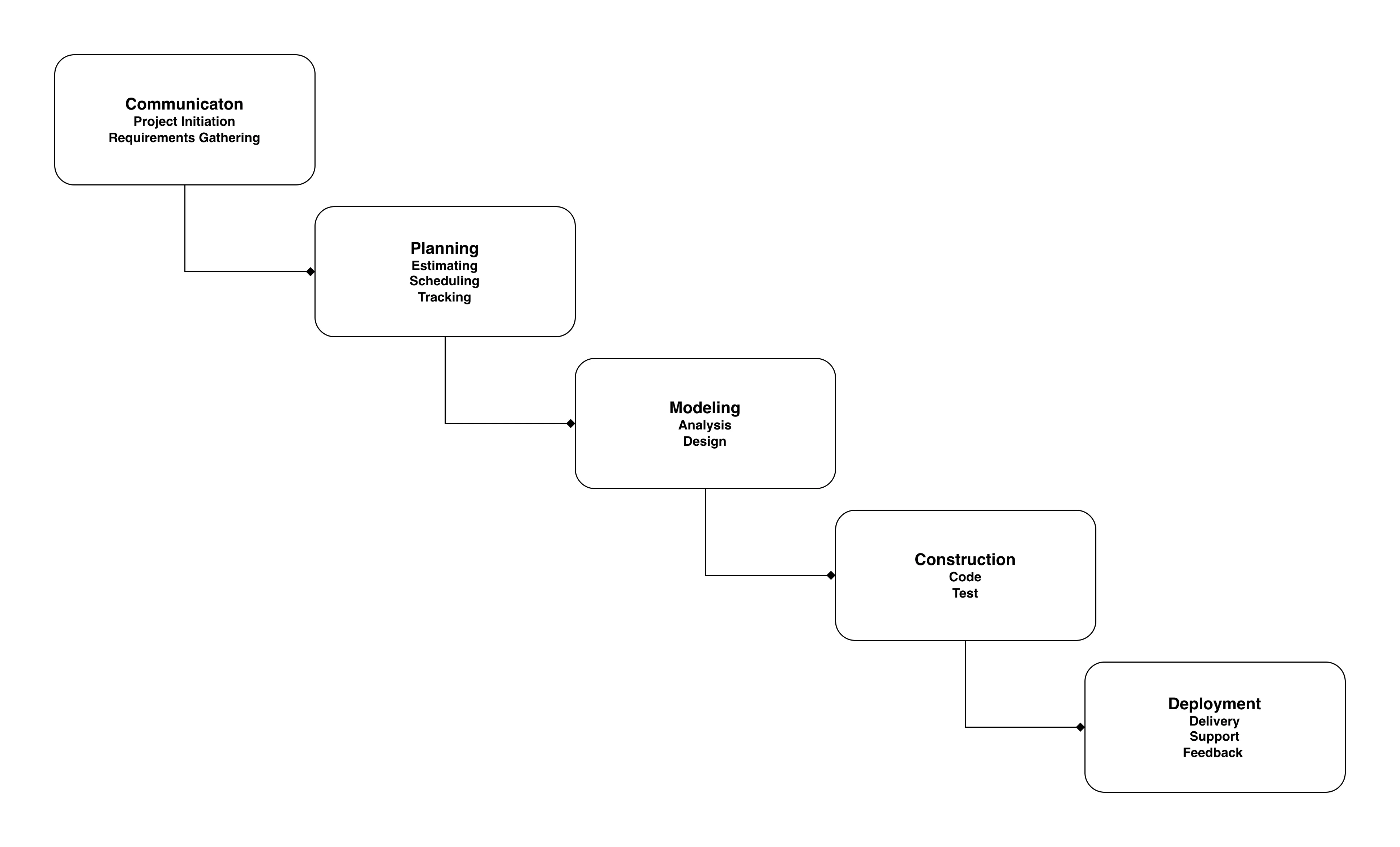
Best-fit conditions:
- requirements are stable and well understood,
- technology is known,
- product scope is relatively small,
- work resembles a new version or straightforward porting effort.
Trade-off: clear planning and straightforward phase control, but weak responsiveness to change and delayed testing/feedback.
Waterfall’s linearity means each phase is meant to be substantially complete before the next begins, which is precisely why it depends so heavily on requirements being stable and well understood from the outset — the model has no efficient built-in mechanism for absorbing a requirement that changes after the design phase has closed. The “delayed testing and feedback” trade-off is one of the model’s most consequential weaknesses: because testing sits near the end of the sequence, a fundamental misunderstanding introduced during requirements can remain invisible until very late, at which point correcting it is far more expensive than it would have been earlier. This is also why waterfall tends to fit smaller, well-understood efforts and porting work best — those are the situations where the assumption of requirement stability is actually realistic rather than aspirational.
Prototyping Model
Prototyping is effective when requirements are unclear or when teams need to validate interaction, technical feasibility, or user acceptance early.
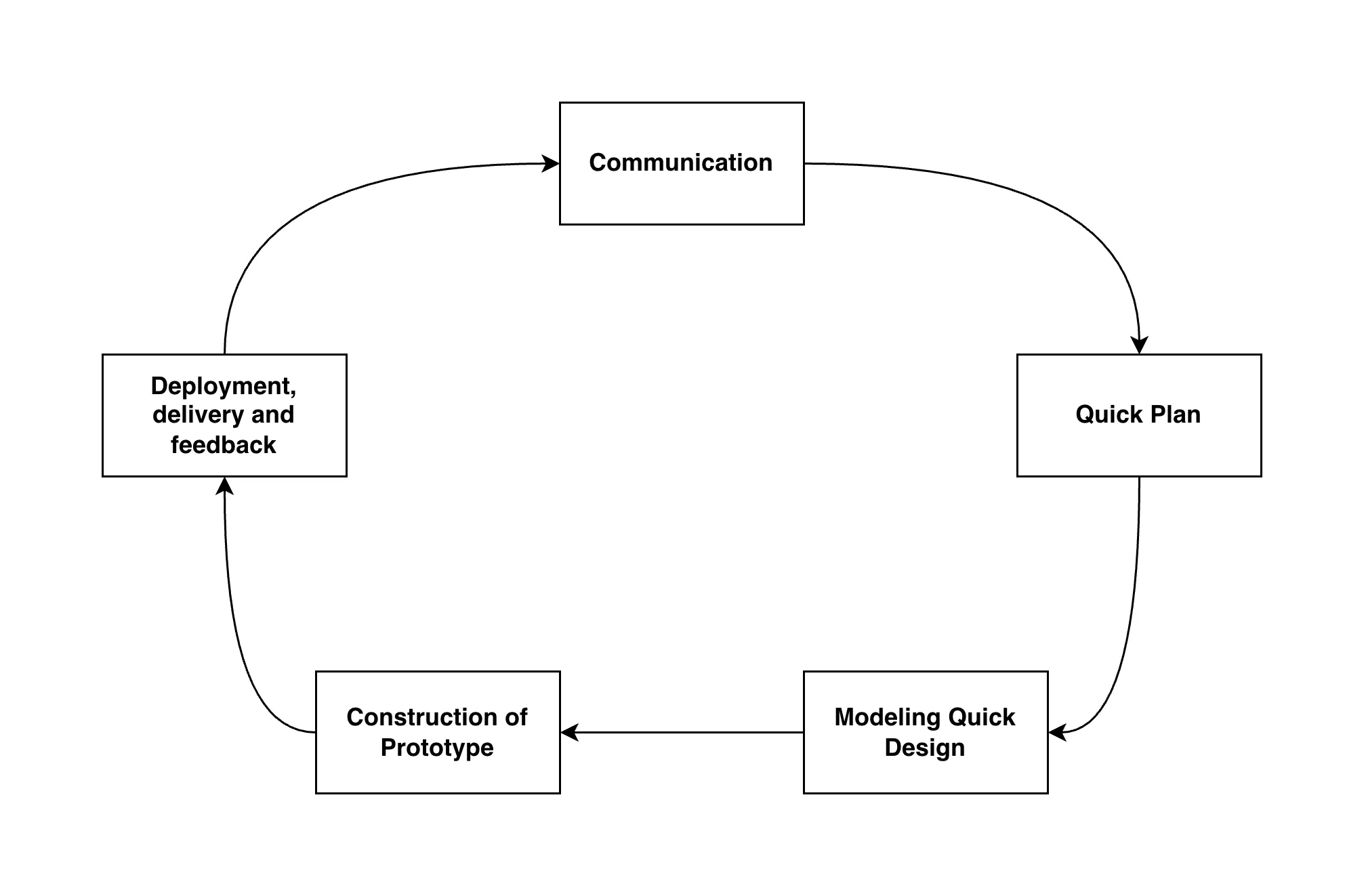
- Throwaway prototypes clarify requirements quickly but are discarded.
- Evolutionary prototypes are iteratively refined into delivery candidates.
Trade-off: strong early feedback and reduced rejection risk, but potential schedule uncertainty and management complexity if scope expands without control.
The distinction between throwaway and evolutionary prototypes reflects two different goals that are easy to conflate. A throwaway prototype exists purely to answer a question — does this interaction make sense, is this technically feasible — and its value comes precisely from being disposable, since keeping it around risks quietly promoting rough, exploratory code into a production system it was never designed to be. An evolutionary prototype, by contrast, is built with the explicit intention of becoming part of the delivered product, so it needs a level of engineering discipline from the start that a throwaway prototype does not. The “reduced rejection risk” benefit comes from showing stakeholders something tangible early, before large amounts of effort have been committed to a direction they may not actually want — but that same openness to feedback is what creates the schedule uncertainty risk, since each round of feedback can reasonably expand what the team believes it now needs to build.
Spiral Model
Spiral combines iterative development with explicit risk analysis at each cycle.
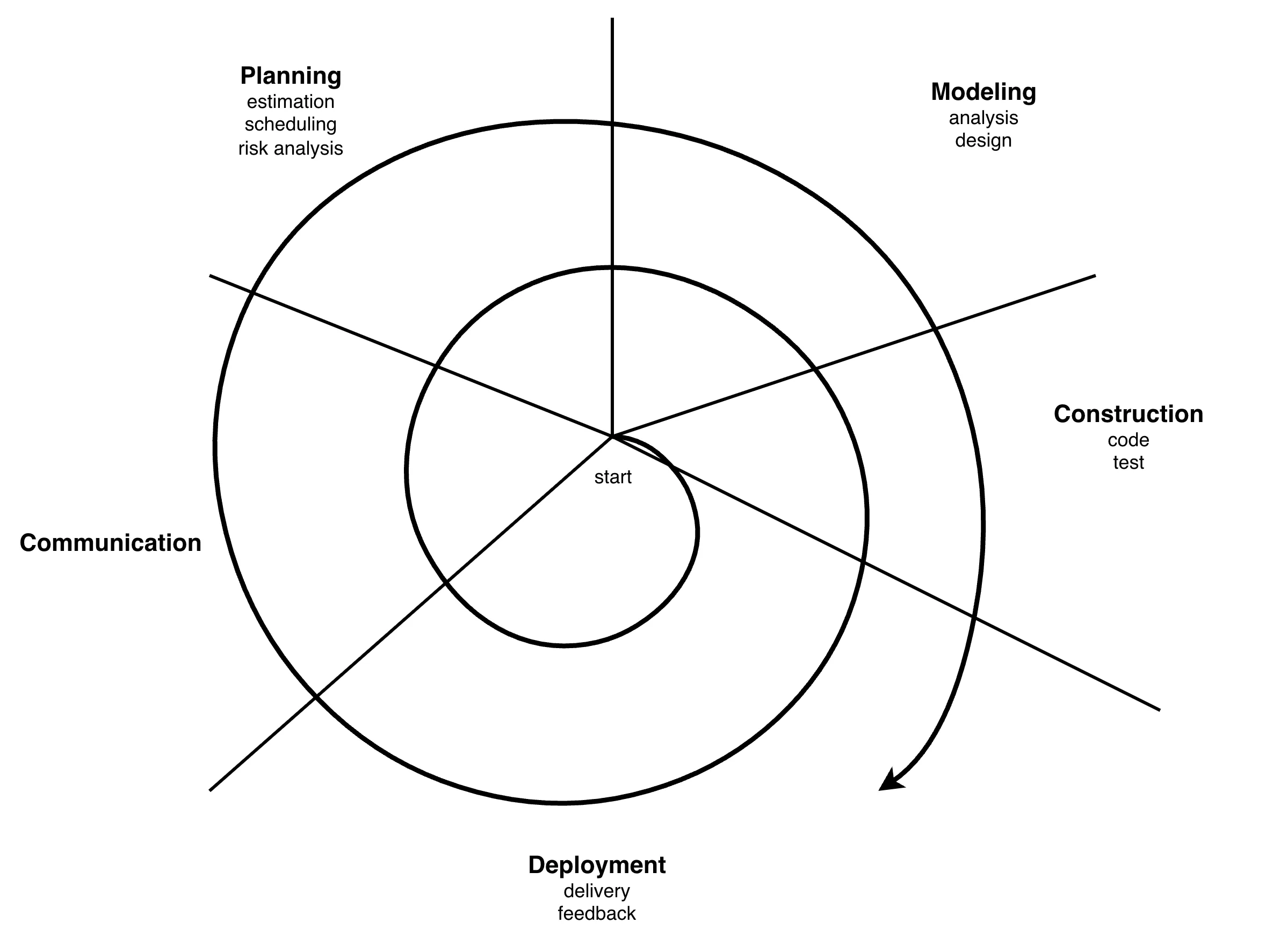
Strength: strong fit for large, expensive, high-risk systems where uncertainty is substantial.
Trade-off: requires experienced teams and disciplined risk-management capability; can be difficult to manage without mature governance.
The spiral model was proposed by Barry Boehm in 1988 as a risk-driven alternative to representing the software process as a strict linear sequence — instead, the process is represented as a spiral in which each loop, or cycle, corresponds to a phase of the project, with the innermost loop typically addressing feasibility and later loops addressing requirements, design, and so on [1]. Each cycle around the spiral is split into the same four sectors: setting objectives and constraints for that cycle, identifying and evaluating risks against those objectives, carrying out development and validation once risks have been addressed, and planning the next cycle [2]. This structure is what makes the spiral model so well suited to large, high-risk systems: rather than committing to one process for the whole project, each cycle can effectively behave like whichever existing model — waterfall-like, prototyping-like — best matches the dominant risk at that particular stage, giving the team a framework that adapts as the project’s own risk profile changes. The trade-off is direct: identifying and evaluating risk accurately at every cycle is a genuinely difficult skill, which is why the model demands more experienced teams and more mature project governance than a simpler, single-pass model would.
Unified Process (UP)
Unified Process blends iterative and incremental flow with architecture-centric and use-case-driven practices.
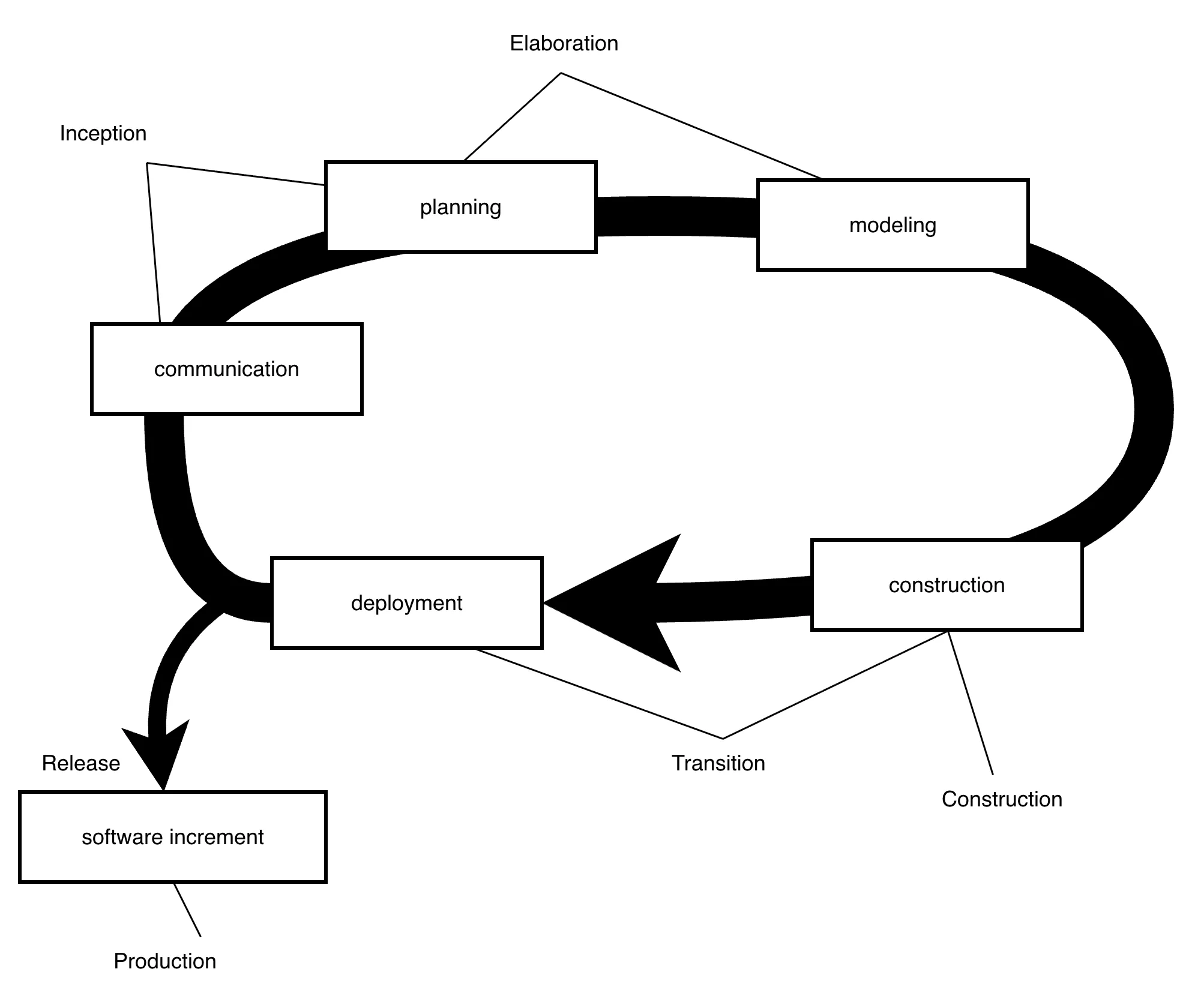
Strength: supports structured documentation and evolving requirements.
Trade-off: phase overlap and integration complexity can increase process overhead.
UP’s “architecture-centric, use-case-driven” character means the process is organized around two anchors at once: use cases capture what the system must do from a user’s perspective, while an evolving architecture captures how the system will be structured to do it, and the two are meant to inform each other iteratively rather than being finalized separately in sequence. This lets UP support evolving requirements far more gracefully than a strict waterfall approach, since each iteration can revisit and refine both the use cases and the architecture together as understanding improves. The overlap between phases that gives UP this flexibility is also its main cost: because activities like requirements, analysis, and design are not cleanly separated in time the way they are in waterfall, keeping the documentation and the architecture consistent across concurrent iterations takes real process discipline, and that coordination overhead is what teams are trading for the model’s adaptability.
Agile Models and Adaptive Delivery
Agile models prioritize rapid value delivery, short feedback loops, and adaptation under changing requirements.
Agile as a named movement traces to a specific event: in February 2001, seventeen practitioners representing methods including Extreme Programming, Scrum, and others met at a ski resort in Snowbird, Utah, to find common ground across their different approaches, and the result was the Manifesto for Agile Software Development [3]. What came out of that meeting was not a single method but a shared set of values and principles — prioritizing individuals and interactions, working software, customer collaboration, and responsiveness to change — that the specific frameworks below each implement in their own way [4]. That distinction matters practically: “agile” is not itself a process to follow, so a team choosing “to be agile” still has to choose or design a concrete framework, such as one of the following, that actually embodies those values.
Scrum
Scrum operationalizes iterative delivery through backlog refinement, sprint planning, daily synchronization, sprint review, and retrospective.
- Works well when product priorities evolve.
- Depends on disciplined roles and team maturity.
Each of Scrum’s ceremonies answers a different coordination problem. Backlog refinement keeps the list of upcoming work realistic and ready to plan from, rather than letting it grow into an unmanageable, poorly understood queue. Sprint planning commits the team to a specific, bounded slice of that backlog for the coming iteration, which is what allows priorities to keep evolving between sprints without destabilizing the sprint currently in progress. Daily synchronization surfaces blockers quickly, before they can silently consume days of a short sprint. Sprint review and retrospective close the loop in two different directions — review checks whether the right thing was built by showing it to stakeholders, while retrospective checks whether the team is working the right way and adjusts its own process. Because these ceremonies only produce their intended benefit when everyone actually engages with them honestly, Scrum’s dependence on team maturity is not a minor caveat — a team that treats the ceremonies as a formality rather than a working discipline tends to get the overhead of Scrum without its actual benefits.
Extreme Programming (XP)
XP emphasizes engineering rigor through unit-first testing, pair programming, refactoring, and frequent acceptance feedback.
- Effective for quality-centric teams.
- Sensitive to team skill depth and collaboration quality.
XP’s practices are best understood as a mutually reinforcing set rather than a menu to pick from individually. Writing unit tests before the corresponding code (unit-first testing) forces a developer to clarify exactly what “correct” means for a piece of functionality before building it, which in turn makes continuous refactoring safe, since a comprehensive test suite catches regressions immediately rather than letting them surface later. Pair programming adds a second layer of real-time review that catches design and logic issues as code is written rather than in a separate review step afterward, and it also spreads knowledge of the codebase across the team as it is built rather than concentrating it in whoever wrote a given piece. Frequent acceptance feedback closes the loop with the customer at short intervals, which keeps the team’s understanding of “done” aligned with what is actually wanted. Because each of these practices depends on the others to be effective — refactoring without tests is risky, pairing without discipline is just slower solo work — XP’s sensitivity to team skill and collaboration quality is a direct consequence of how tightly its practices are coupled together.
Kanban
Kanban optimizes workflow visibility and work-in-progress limits.
- Useful for continuous flow contexts.
- Can lose direction if business analysis and prioritization are weak.
Kanban did not originate in software at all — the term and the underlying visual workflow-control concept trace back to Toyota’s manufacturing system in the 1940s, where it was used to achieve just-in-time production by limiting how much work-in-progress moved through the system at once [5]. Applied to software, that same idea becomes a board that visualizes each unit of work as it moves through stages, with explicit limits on how many items can sit in a given stage at once — a constraint that exposes bottlenecks in real time rather than letting them hide inside a backlog. Unlike Scrum, Kanban does not prescribe fixed roles or fixed-length iterations, which is exactly what makes it well suited to continuous flow work where items arrive and complete on their own schedule rather than in synchronized batches. That same lack of prescribed structure is also its main weakness: without strong business analysis and prioritization happening outside the board itself, a team can keep work flowing smoothly through the board while still working on the wrong things in the wrong order, since Kanban’s visibility says nothing on its own about whether the right items were pulled onto the board in the first place.
DevOps-Oriented Delivery
DevOps extends agile development into operations through continuous integration, testing, deployment, and monitoring.
- Reduces release latency.
- Requires automation maturity and strong cross-functional ownership.
DevOps addresses a gap that agile development methods, on their own, tend to leave open: agile speeds up how quickly a team can build and validate software, but says comparatively little about how that software actually reaches production reliably and how it is watched once it is live. Continuous integration and continuous deployment close that gap by automating the build, test, and release pipeline so that a validated change can move toward production quickly and repeatedly rather than through an infrequent, manual release event. Monitoring closes the loop the other direction, feeding real production behavior back to the team so that operational issues are caught and attributed quickly rather than discovered through user complaints. The requirement for “strong cross-functional ownership” reflects DevOps’ core cultural claim: release latency only drops sustainably when the people who build the software and the people who operate it share responsibility for its production behavior, rather than treating a handoff between “development” and “operations” as the natural dividing line.
How to Select a Model in Practice
A model should be selected by evaluating project context across key dimensions:
- Requirement volatility
- Risk profile (technical, schedule, business)
- System criticality
- Team expertise and size
- Governance and compliance obligations
- Need for early user-visible increments
No single model dominates across all contexts. The right choice is conditional.
These six dimensions work together as a diagnostic rather than a checklist to satisfy individually. Requirement volatility and the need for early user-visible increments both point toward how much the team needs feedback loops built into the process itself, while risk profile and system criticality point toward how much upfront analysis and formal verification the project can afford to skip. Team expertise and size determine whether a project can actually execute a demanding model like spiral or XP well, regardless of how well-suited that model looks on paper — a technically ideal process run by a team that lacks the discipline it requires often performs worse than a simpler process run competently. Governance and compliance obligations can override the other five dimensions entirely in regulated contexts, where a certain degree of prescriptive documentation may be a legal requirement rather than a preference. Reading these dimensions together, rather than picking the model that scores best on any single one, is what turns model selection from guesswork into a reasoned decision.
A Practical Selection Heuristic
- Use waterfall-like structure when regulatory traceability and requirement stability are high.
- Use prototyping when requirements are ambiguous and user interaction is uncertain.
- Use spiral when risk is dominant and must be assessed explicitly each cycle.
- Use agile models when change is expected and frequent value delivery is essential.
- Combine with DevOps practices when release cadence and production feedback are strategic priorities.
This aligns with the principle that every project needs a roadmap, but the roadmap should be adapted to project realities.
Each line in this heuristic maps a project characteristic directly to the model whose core design assumption matches it — which is exactly why none of these five bullets should be read as a universal recommendation. A project rarely presents just one of these characteristics in isolation; a large government system, for instance, might have both high regulatory traceability needs and substantial technical risk, in which case elements of waterfall-like documentation and spiral-like risk cycles can be combined rather than treated as mutually exclusive choices. The heuristic is meant to be a starting diagnostic, pointing toward which model’s underlying assumptions best match the situation at hand, not a rule that forces a single, pure model onto every project regardless of fit.
Adapting, Not Blindly Adopting
A recurring principle is that process should be tailored, not copied. Effective teams:
- retain structure where coordination is required,
- remove unnecessary ceremony where it adds no value,
- involve stakeholders early and often,
- and integrate testing before late-stage construction bottlenecks form.
Thus, process rigor and agility are not opposites; effective engineering combines both.
Retaining structure where coordination is required and removing ceremony where it adds no value are really the same judgment applied in two directions: both ask whether a given process element is earning its cost in this specific project, rather than assuming a textbook process model should be followed exactly as written. A team with several groups working on tightly coupled components may need more structured coordination than a pure Scrum implementation prescribes, while a small, co-located team may find several of Scrum’s ceremonies redundant with the informal communication that already happens naturally. Involving stakeholders early and often, and integrating testing before late-stage bottlenecks form, are both direct countermeasures against the two failure modes that show up repeatedly across the prescriptive models discussed earlier — late discovery of a wrong requirement, and late discovery of a defect — regardless of which named process model a team nominally follows. This is why the framing of “process rigor and agility as not opposites” is more than a diplomatic compromise: the actual goal of both is the same, catching problems while they are still cheap to fix, and the named models are just different strategies for achieving that goal under different constraints.
Conclusion
Process models are decision frameworks for controlling uncertainty. Waterfall, prototyping, spiral, UP, and agile families each provide value under different constraints. Selection quality depends less on trend popularity and more on fit with requirement volatility, risk, team capability, and delivery goals. The most reliable strategy is principled adaptation supported by continuous stakeholder feedback and measurable project control.
Across every model discussed here, the underlying question is the same one this whole comparison has been circling: where in the project’s timeline can the team afford to discover it was wrong, and how expensive will that discovery be once it happens? Waterfall accepts late discovery in exchange for upfront predictability; prototyping and agile models pull discovery earlier at the cost of a less fixed plan; spiral makes the cost of being wrong the explicit subject of every cycle. Choosing well means naming, honestly, which kind of “being wrong” a given project can least afford — and picking, or combining, the models that protect against exactly that.
References
- University of Babylon — Boehm’s Spiral Model: A Risk-Driven Software Process
- software-engineering-book.com — Boehm’s Spiral Model of the Software Process
- Agile Manifesto — History: The Agile Manifesto
- GitHub Topics — Agile (Manifesto values and 12 principles)
- LinkedIn — Understanding AGILE, SCRUM, and KANBAN